Alhambra Wood Flooring handles engineered hardwood refinishing in Alhambra, CA, and every job starts the same way: by measuring the wear layer. With more than 20 years in wood flooring, we have seen too many engineered floors ruined by someone who treated a thin veneer like a solid board and sanded straight through it.
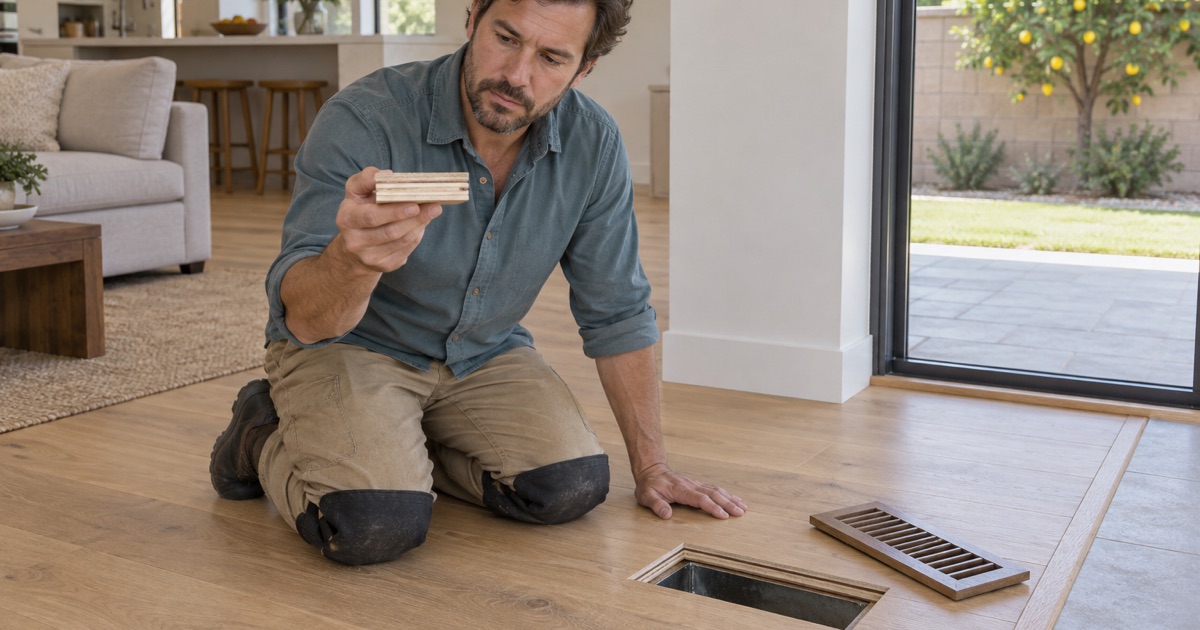
An engineered floor has a real hardwood surface bonded to a plywood or composite core. That surface can be renewed, but how far it can be renewed depends entirely on its thickness. Measuring first lets us promise only what your floor can actually take.
Wear Layer Thickness Decides What Is Possible
Thick Veneers That Can Take A Full Sand
Engineered floors with a generous wear layer can be sanded down to fresh wood, stained if you wish, and finished much like solid hardwood. We use a lighter sanding approach than on a solid floor, removing only as much as needed to clear scratches and old finish, so the veneer keeps as much thickness as possible for the future.
Edges get particular care. The edger and the transition between the edges and the field of the floor are where sand-through most often happens, because those passes can dip deeper than the main sanding. We keep the edger light and check the veneer as we go rather than trusting the machine.
Thin Veneers And Screen And Recoat
Many engineered floors have a veneer too thin to sand safely. For those, a screen and recoat is the right tool: we abrade the existing finish without cutting into the wood and apply fresh coats. It refreshes dull, scuffed floors well, though it cannot remove deep scratches or stains in the wood itself.
The timing of a recoat matters as much as the method. A floor recoated while its finish is merely dull keeps its veneer protected for years, while a floor left until the finish wears through to bare wood in the walkways has lost the chance for a simple recoat in those areas. Scheduling one before that point is the cheapest maintenance an engineered floor can get.
When A Floor Cannot Be Refinished
Some floors have little or no usable veneer left, have already been sanded through in spots, or have damage that has reached the core. In those cases, refinishing would not solve the problem. We tell you plainly, and discuss replacing damaged boards or the floor.
A partial answer is sometimes possible. If only a traffic lane or an entry has worn through, replacing those boards with matching stock and recoating the whole room can extend the floor’s life for far less than a new installation, provided the product is still available or a close match can be found.
Surface And Finish Challenges On Engineered Floors
Factory Finishes And Adhesion
Prefinished engineered floors often come with durable factory coatings that resist new finish bonding to them. Before recoating, we clean the floor thoroughly, remove any polish or residue, abrade the surface and test a small area. The recoat goes ahead only when the test shows the new finish bonds properly.
Beveled Edges And Micro-Bevels
Many engineered boards have beveled edges where dirt and old finish collect. Full sanding does not reach into those grooves, so they need hand cleaning before finishing. On a thin veneer, sanding flat enough to remove the bevel would cut too deep, which is another reason a recoat is often the better approach.
Wire-Brushed And Textured Surfaces
Wire-brushed and hand-scraped textures are part of the look of many engineered floors. A full sanding would erase that texture along with a good part of the veneer. We usually recommend cleaning and recoating textured floors, so the character stays while the protective finish is renewed.
Moisture, Delamination And Repairs
Delamination And Veneer Lifting
When water gets into an engineered floor, the veneer can separate from its core and lift or bubble. Delaminated boards cannot be sanded or recoated back to health. We identify them, replace them with matching boards where available, and look for the moisture source before refinishing the surrounding floor.
Glue-Down And Floating Engineered Floors
Engineered floors are often glued to a slab or installed as a floating floor over underlayment. A hollow sound under a glue-down floor may mean the adhesive has released, and a floating floor that shifts or gaps may have lost its expansion space at the walls. We check for these before refinishing, since a new finish will not fix a floor that moves.
A floating floor also limits how aggressively it can be sanded, because the boards can shift slightly under the machine. On those floors we lean toward screening and recoating even when the veneer would technically allow more, so the locking joints are not stressed during the work.
Finishes For Refinished Engineered Floors
Low-Sheen Waterborne Finishes
Most refinished engineered floors in homes receive a waterborne polyurethane in a satin or matte sheen, which keeps the natural wood tone and hides everyday scratches. These products meet the South Coast air district’s 275 grams per liter wood coatings limit, which rules out some finishes sold in other states.
Planning Around Cure Time
Engineered floors usually go in living areas that households need every day. We schedule the work room by room where possible, and your written schedule shows when each room can take foot traffic, when furniture can return, and when rugs are safe to put back down.
- 20+ Years in Wood Flooring
- Free Written Estimates
- Room-by-Room Schedules