Alhambra Wood Flooring provides water damaged hardwood floor repair in Alhambra, CA, serving surrounding cities including South Pasadena, San Gabriel, Monterey Park, San Marino and Rosemead. For more than 20 years we have helped homeowners, landlords and property managers work out what a wet floor needs, from simple drying and refinishing to replacing boards and the subfloor beneath them.
Water damage is a timing problem as much as a wood problem. The first hours decide how far water travels under the boards, and the following weeks decide whether a cupped floor settles back or is sanded too early and ruined. We take moisture readings from the start, record them, and make every repair decision from those numbers rather than from how the floor happens to look that day.
We also keep records built for insurance. Photos, dated moisture readings and a written scope describing matching boards and finish give your adjuster a clear picture of the loss and of the work needed to put the floor back the way it was.
What Water Does To A Hardwood Floor
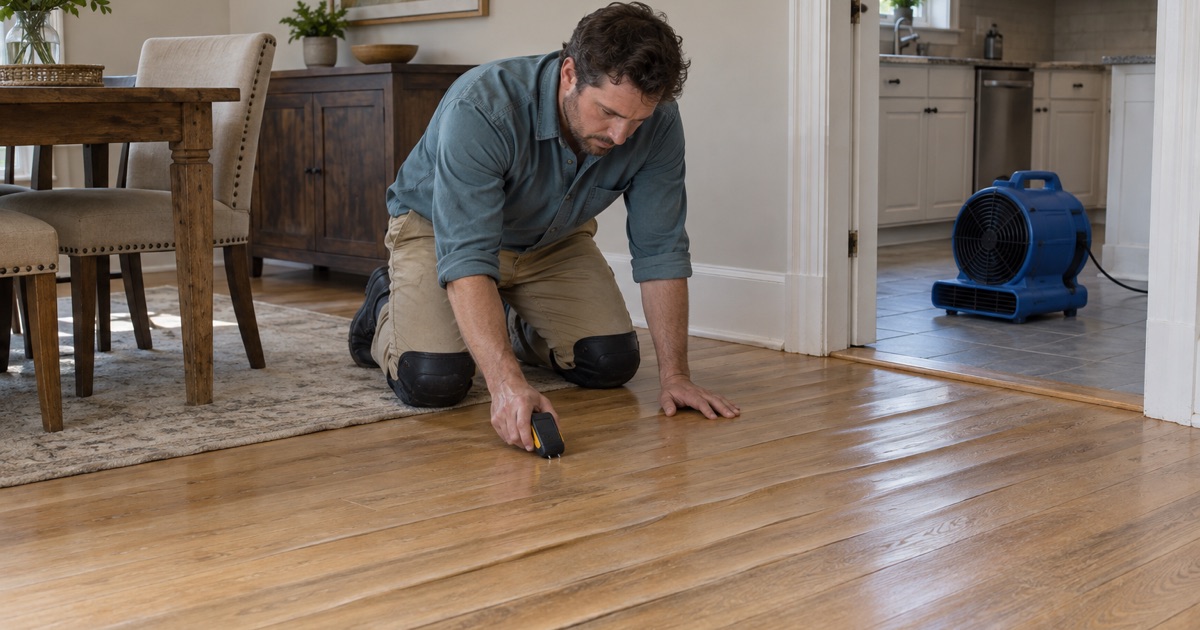
Cupping, Crowning And Buckling
Wood absorbs water and swells. When the bottom of a board takes on more moisture than the top, the edges rise and the board cups. If the swelling is severe and the floor has nowhere to expand, boards can push against each other and the walls and lift off the subfloor entirely, which is called buckling.
Cupping can often reverse as the floor dries, which is why patience matters. Buckled boards have usually broken their fasteners or glue bond and need to be taken up and reinstalled or replaced.
Stains, Finish Damage And White Haze
Water that sits on a finished floor can cause cloudy white haze in the finish, while water that reaches the wood can leave gray or black stains. Gray stains may sand out. Black water stains, especially where water reacted with the tannins in oak or sat for a long time, usually go too deep and those boards are replaced.
Damage You Cannot See From Above
Water runs along the subfloor, under walls and into the crawl space or across a slab. A floor that looks fine a few feet from the leak can still be wet underneath. Moisture readings across the room, and under the house on a raised foundation, show how far the water actually went.
That hidden moisture also feeds mold and decay if it is left in place. Checking the subfloor and framing early is how a leak stays a floor repair instead of becoming a structural one.
The First Days After A Leak Or Flood
Stop The Water And Clear The Floor
The first steps are simple and urgent. Shut off the water at the source, remove standing water, and take wet rugs, pads and furniture off the floor so the wood can breathe. Anything left sitting on a wet floor traps moisture and can leave stains or dye transfer.
Moisture Readings And A Drying Plan
We measure moisture in the affected boards and compare it with readings in a dry part of the same house. That comparison is the drying target, because every home has its own normal equilibrium moisture content. On a raised foundation we check the subfloor and framing from the crawl space, and on a slab we check how far water spread across the concrete.
Drying may involve air movers, dehumidifiers and, in some cases, specialized floor drying mats. The goal is to pull moisture out evenly, not to heat the surface quickly and crack the boards.
Monitoring Until The Floor Is Stable
We return to take readings as the floor dries, logging each set so you and your adjuster can see progress. As the numbers approach the target, cupped boards often start to flatten. Only when the damaged area reads close to the unaffected area do we decide what can stay and what must go.
Repairing The Floor After It Dries
Sand And Refinish When Boards Recover
If the boards have flattened and the stains are shallow, the floor may only need sanding and refinishing. Any remaining slight cupping is sanded flat once the moisture is back to normal, and the finish is renewed across the room so the repaired area does not stand out from the rest of the floor.
When the water crossed into a hallway or an adjoining room with no threshold between them, the refinishing usually has to carry through to a natural stopping point. A new finish that ends in the middle of an open floor leaves a visible line, which is the kind of result a repair is supposed to avoid.
Board Replacement And Weave-In Repair
Boards that stayed cupped, buckled, cracked, stained black or grew mold are removed. We match species, width, thickness and grade, and weave new boards into the existing floor with staggered joints rather than cutting a square patch. The full area is then sanded and finished together so the new wood blends in.
When a floor is old or unusual, matching boards can take time to find. We tell you that early so the drying period can be used to source material rather than waiting after the floor is ready.
Subfloor And Framing Repairs
Plywood subfloor that has delaminated, board subfloor that has rotted, or joists that stayed wet too long are repaired before any flooring goes back down. On a raised house, we also check whether the crawl space itself is wet and needs attention, since a floor installed over damp framing will cup again.
Contaminated Water Losses
Water from a sewer backup or outside flooding is treated differently from a clean supply line. Wood soaked by black water is porous and generally removed, along with affected subfloor, rather than dried and kept. Cleaning and sanitizing the area comes before any new material is installed.
A washing machine overflow or a dishwasher discharge falls between the two, carrying some contamination without being sewage. How much of that floor can be kept depends on how long the water sat and how far it traveled, and we explain the reasoning behind each board we recommend removing.
Documentation For Insurance And Landlords
Photos And Moisture Logs
From the first visit we photograph the damage, the extent of wet areas and the readings on the meter. Every return visit adds new readings with dates. That log shows the adjuster how the floor behaved during drying and why each repair decision was made.
It also protects you if the damage resurfaces. A floor that cups again months later raises the question of whether the original leak was fully dried or a new one has started, and dated readings from the first repair make that far easier to answer.
A Scope Written For A Matching Floor
A water loss repair should leave a floor that looks like one floor. Our written scope describes the boards to be replaced, the area to be sanded and refinished so color and sheen match, and any subfloor work, rather than listing a patch that would leave a visible outline.
If an adjuster questions part of the scope, the photos and readings give them something concrete to review. That tends to shorten the back-and-forth and gets the work scheduled sooner.
Rental Units And Shared Buildings
In rentals, condos and townhomes, a leak can involve more than one party: the owner, the tenant, the association and the neighbor whose unit it came from. We document the damage in a way that works for everyone involved, and coordinate access so the repair can go ahead once responsibility is sorted out.
- 20+ Years in Wood Flooring
- Free Written Estimates
- Room-by-Room Schedules