Alhambra Wood Flooring provides hardwood floor installation in Alhambra, CA for solid and engineered floors in homes, rentals and condos. Over more than 20 years we have learned that most installation failures are decided before the first board goes down, in the subfloor, the moisture readings and the choice of fastening method.
That is where our installation work begins. We check the subfloor from above and, on a raised house, from the crawl space, test for moisture, confirm association rules in shared buildings, and only then order material. The result is a floor that stays flat, quiet and tight through the seasons.
Preparing For A New Hardwood Floor
Subfloor Inspection And Flattening
A new floor can only be as flat and solid as what is under it. We check for soft spots, loose sheathing, squeaks and high or low areas. Plywood subfloor is refastened where it moves, board subfloor and diagonal sheathing are assessed for whether they need a plywood layer, and high spots are sanded while low spots are filled.
On raised foundations, any framing issues found in the crawl space, such as a sagging joist or settled pier post, are corrected before installation rather than hidden under new boards.
Moisture Testing Wood And Concrete
We take moisture readings on the new flooring and on a wood subfloor and compare them, since boards installed too wet or too dry will gap, cup or crown later. On a concrete slab, we use testing such as the ASTM F2170 in-situ relative humidity test to decide whether the slab is ready and what vapor protection it needs.
Acclimation And Material Handling
Flooring is delivered and stored in the house with enough time to adjust toward the home’s conditions, and we confirm with readings rather than calendar days alone. Boxes are kept off concrete and away from fresh drywall or paint, which can add moisture.
We also open several boxes and lay boards out before installation begins. Mixing boards from different boxes spreads color and grain variation evenly across the room, rather than leaving a patch of darker or lighter boards where one box was installed all at once.
Installation Methods
Nail-Down Solid Hardwood
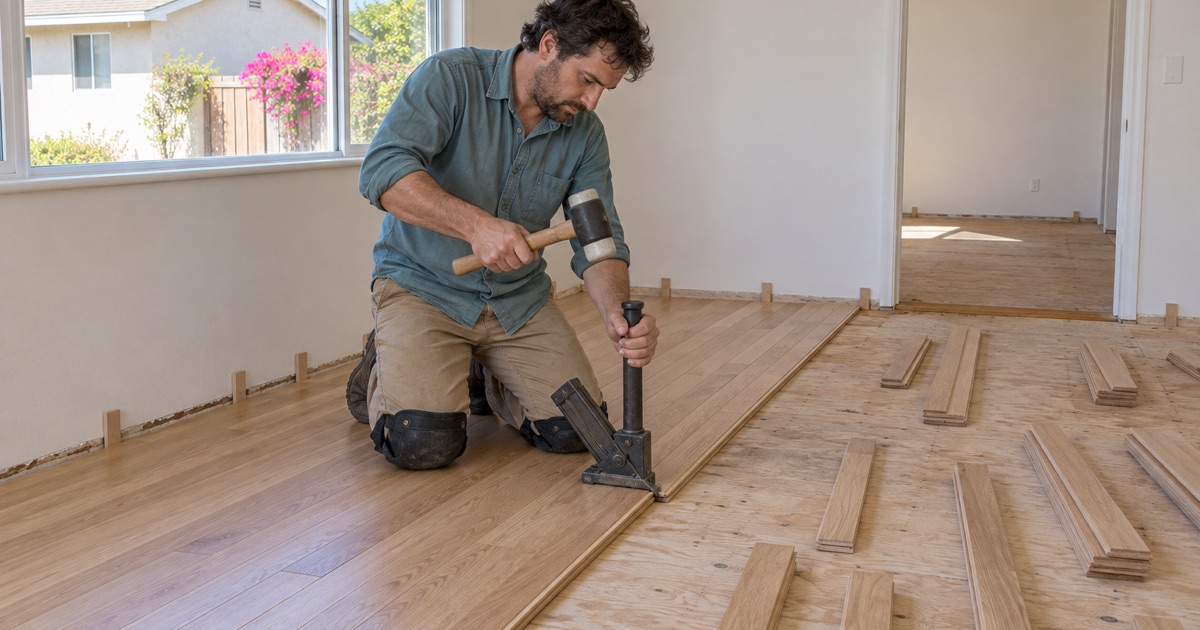
Solid hardwood over a plywood or board subfloor is usually installed nail-down using flooring cleats or staples driven through the tongue. We follow a fastener spacing schedule suited to the board width and use the right staple crown width or cleat for the product, since improper fastening is a common cause of squeaks and loose boards.
An expansion gap is left at the walls and covered by baseboard, shoe molding or quarter round, so the floor has room to move seasonally without buckling. Skipping that gap to save trim work is one of the most common reasons a new floor pushes against the walls and lifts after its first humid season.
Glue-Down Engineered Floors
Over concrete, engineered hardwood is commonly glued down with an adhesive suited to the slab conditions, sometimes one that also acts as a moisture barrier. Full adhesive coverage matters: gaps in the spread lead to hollow spots that sound and feel different underfoot.
The slab has to be clean and flat for the adhesive to bond. Old adhesive residue, paint, curing compounds and high ridges are removed or ground down, and low areas are filled with a suitable patching compound before any boards are set in place.
Floating Floors Over Underlayment
Some engineered products are designed to float, locking together over an underlayment without being fastened down. Floating floors need a flat subfloor and full expansion space at every wall and fixed object. Pinning a floating floor under a cabinet or a heavy island can cause it to buckle when it expands.
Floating floors are popular where fastening is restricted or where a floor must go over an existing hard surface. They are quick to install, but they feel and sound different underfoot than a nailed or glued floor, so we make sure you have walked on one before choosing it for a whole house.
Condos, Townhomes And Shared Walls
Association Rules And Approvals
Many associations require approval before hard flooring is installed and set standards for underlayment. We read those rules, confirm what documentation the association wants, and match our materials to them before ordering. That avoids the expensive scenario of removing a new floor that did not meet the building’s requirements.
Acoustic Underlayment
In stacked units, footfall noise carries to neighbors below. Acoustic underlayment reduces that transfer, and associations often rate requirements by impact insulation class or sound transmission class. We choose underlayment that meets the association’s written requirement for the assembly.
Finishing The Installation
Transitions, Reducers And Molding
Where hardwood meets tile, carpet or another floor, we install transition strips, reducers or thresholds so height changes are smooth and safe. Stair nosings finish the edges at stairs and landings. Baseboard and shoe molding cover expansion gaps neatly around the room.
Doors often need attention too. A new floor that is taller than the old one can leave doors dragging, so we check clearances before installation and plan for trimming doors or adjusting thresholds as part of the job rather than discovering it afterward.
Site-Finished Floors
Unfinished hardwood is sanded flat after installation and finished in place, which seals the seams and allows any stain color. Finishes are chosen from products that meet the South Coast air district’s 275 grams per liter limit for wood coatings, and your schedule shows when each room can return to use.
- 20+ Years in Wood Flooring
- Free Written Estimates
- Room-by-Room Schedules